Trying to learn Swahili in Nairobi?
Join more than two hundred students who have used Swahii to learn Kiswahili as it is spoken and used in Kenya.
Why Swahii?
Many foreigners in Nairobi take Swahili classes, learning the standardized form of the language, including many formalities and noun classes seldom used in everyday speech in Nairobi—only to seldom use what they learn, fail to become fluent, and often feel guilty about it all. But it’s no surprise that a language is difficult if one is sent around speaking a version of it that isn’t used.
The point of Swahii is to put aside normative judgments about Nairobi Swahili being “grammatically incorrect” and just teach it as a colloquial, practical form of the language. People in Nairobi didn’t use all the many ngeli there are, so why should Swahili students in Nairobi? Those interested in studying Swahili literature should learn “the right way” but, for most students, the goal isn’t to write a dissertation—it’s to get to know people and break down the language barrier.
To do that, you need to learn to speak to people like they do to one another.
How Swahii works
This course is broken up into thirty lessons, which altogether will give you what you need to know to be conversationally fluent in Nairobi Swahili. Once you’ve purchased the course, you can access all of the material forever, which means being able to learn at your own pace, from wherever you are in the world.
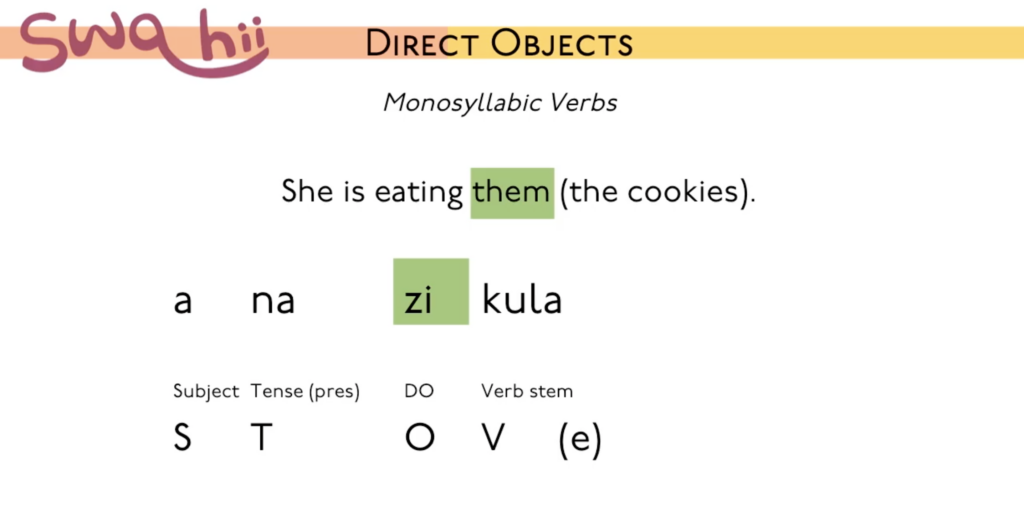
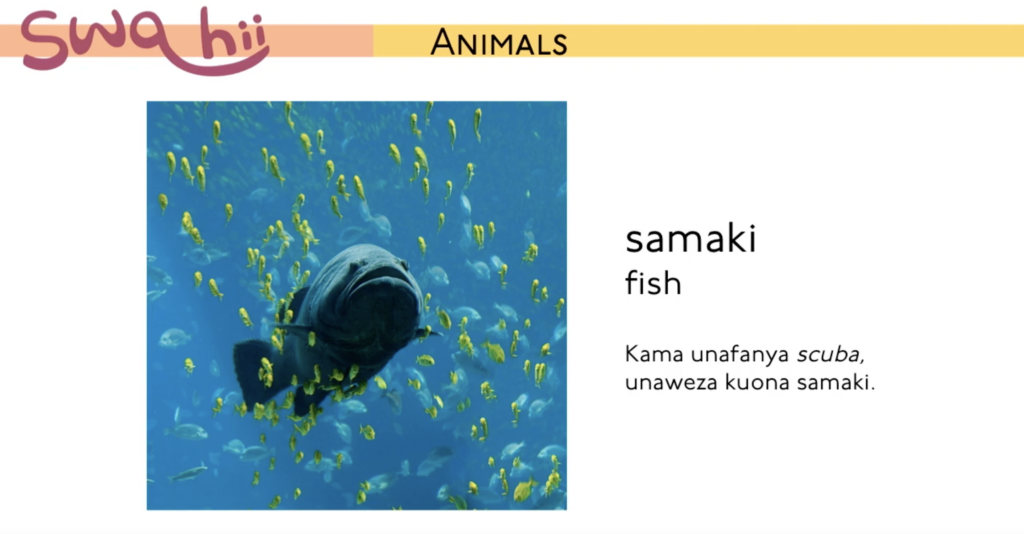
The course is also designed to work with as many learning styles as possible. With every new grammatical concept comes a short video that explains it—also so you can hear how things are pronounced.
There is also a detailed pdf for each lesson, which you can download and print. Included on these documents are plenty of exercises (and their answers). There is also a Memrise course that corresponds to the vocabulary we introduce in every lesson, so you have flashcards you can access from your phone or computer anywhere.
Finally, there are some audio-only exercises too to help with comprehension, and where we also go over some nuances in the way people speak.
Click here to watch an introduction video that shows what the course looks like.
Frequently Asked Questions
Why teach Nairobi Swahili at all?
The idea for this curriculum began with the fact that many foreigners in Kenya find it very difficult to learn Swahili, even as the form of the language Kenyans generally speak to one another is grammatically simpler than standardized Swahili and often incorporates English.
The point of Swahii is to put aside normative judgments about Nairobi Swahili being “grammatically incorrect” and just teach it as a colloquial, practical form of the language. People in Nairobi didn’t use all the many ngeli there are, so why should Swahili students in Nairobi? Those interested in studying Swahili literature should learn “the right way” but, for most students, the goal isn’t to write a dissertation—it’s to get to know people and break down the language barrier. To do that, you need to learn to speak to people like they do to one another.
What resources are included in this course?
We try to be inclusive of all learning styles to make sure that something works for everyone. Each lesson has between 8 to 20 minutes of videos that go through the grammar, so you can see how things work and hear the pronunciation of words. There is also a “textbook” as a downloadable PDF for each lesson, which includes a whole lot of exercises (with answers, of course, so you can check), for those visual learners. And finally there is a Memrise course (open to the public) which has online flash cards that correspond to each lesson so you can continue to memorize vocabulary even when you’re on the go.
How long do I have access to the course?
How about forever? If you make a one-time purchase of the entire course, you have unlimited access to it for as long as you like.
When does the course start and finish?
The course starts now and never ends! It is a completely self-paced online course, you decide when you start and when you finish. As for how long it takes to finish, this is totally up to you. The course is designed to fit over a variety of schedules and learning paces. There are 30 lessons, each with 8 to 20 minutes of video, plus plenty of exercises with answers. So if you do one a week, you could clear the whole course in 7-8 months. If you are super intense or a really fast language learner, you could make it through the course in as little as 2-3 months.
Didn’t this course used to be on Teachable?
Since the course went live in 2017, it was hosted on an e-learning platform called Teachable that was great: it allowed students to access the course on a streamlined mobile app that also worked offline. The platform would take a cut of the revenue.
However, in 2026, Teachable changed its business model so that creators were forced to buy a subscription that cost over $800 a year. If this was not paid, Teachable would deny access to the course for students, even though the students were promised Lifetime Access at the point of purchase. We could not afford to pay that amount and, more importantly, we did not believe it was fair for us to lose money keeping open a school that we had created. We didn’t want to work with a company that held our own labor and students hostage to extract rent. In 2026, we created swahii.org so that the course could be independently hosted on its own stable website.
What if I am unhappy with the course?
We want to make sure you are satisfied with this course. If for whatever reason you are not happy with your purchase, contact us in the first 30 days and we will give you a full refund.
Should I use Swahii if I am living and working in Tanzania or elsewhere on the East African Coast?
If you are going to be in an area where people speak and write in standardized Swahili, there are a wealth of other resources, whether books or courses, that will suit you better. We believe in finding the most direct, easy-to-understand way to learn the language for the place you’re in, so if that place is Tanzania, it makes more sense to learn it the way that people speak it there.
That being said, some people have found the way that grammar is taught in this course helpful as a foundation, even if they will move towards standardized Swahili eventually. We do our best to keep students aware of the differences between Nairobi Swahili and standardized/traditional Swahili all throughout the course. We want to make it easy for you to do you. If you find within the first 30 days that this course is really not helpful for where you will be speaking Swahili (no questions asked), you can still get a full refund!
Why wouldn’t I learn Swahili from an East African teacher?
As of yet, there are no other teachers who are teaching this colloquial version of Swahili. Sometimes people who have had to learn a less-documented language from scratch tend to be able to explain grammar in a way that makes more sense than native speakers would. In any case, there are plenty of resources written by East Africans and plenty of East African teachers who can teach standardized Swahili to a very high standard! This course is for those who are not pursuing that.
This curriculum has gone through a few iterations with over a dozen different students, so it has been designed and refined to best explain concepts about Swahili grammar in a way that makes the most sense to English-speakers.